Impact of online fashion on fashion shops epq
There are a number of reasons as to why there has been so many failures to fashion shops decreasing ever since online shops became a thing. For example, Amazon has been the prime example of a strong vision for online which is now being realised with huge scale. Their annual UK turnover, third only to their US and German business, exceeded £8.8 billion in 2017. However, more companies are now mixing online with ‘bricks and mortar’ facilities, so in the UK, strong performers include supermarkets such as Tesco and Sainsbury's as well as high street retailers such as Next and Argos, and up and coming online firms such as ASOS. Another reason why there has been failures to fashion shops is because of people changing there shopping habits. For example, Before concerns over the internet impacts, out of town shopping centres were seen as hitting the high street. Free parking, easy access, family-friendly and weather-proof alternatives to fighting it out in a busy town centre every Saturday. The large number of smartphone users in the UK is also driving us to know the price of everything, so before making significant purchases it’s now easier than ever to check online to see if you are getting a good deal.
The rise and rise of online shopping is thought to be a major factor in the decline of the 'high street'.
https://talkinginfluence.com/2021/01/15/how-are-fashion-brands-utilising-social-media-influencers/
https://www.theguardian.com/fashion/2020/apr/07/fast-fashion-speeding-toward-environmental-disaster-report-warns
Secondary research-
Environmental harm on fast fashion:
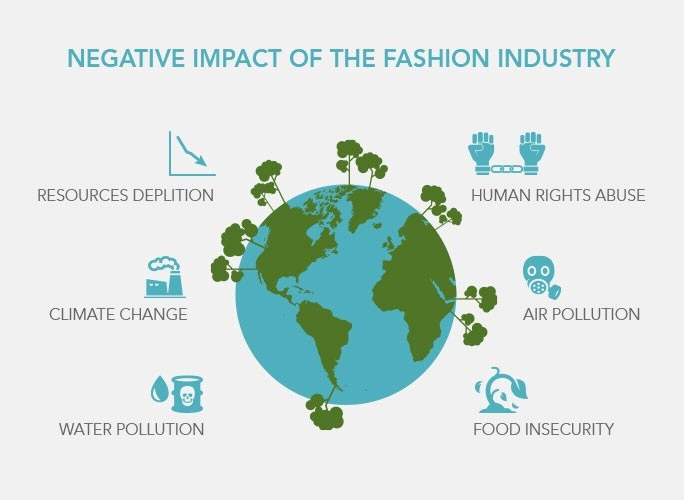
he fashion industry produces 10% of global carbon dioxide emissions every year, while it is estimated to use around 1.5 trillion litres of water annually. Meanwhile concerns have been rising about pollution, from chemical waste to microplastics.
Among the developments deemed to be exacerbating the problems, is fast fashion – cheap clothes bought and cast aside in rapid succession as trends change – such as the £1 bikini sold by Missguided last year.
The use of chemicals, carbon dioxide emissions, textile waste not only pose environmental risks, but health risks for those involved in the industry. For example, ' a single European textile-finishing company uses over 466g of chemicals per kilogram of textile'.
'The waste water is going out into freshwater streams and polluting the rivers that people are fishing from and living from, therefore limited natural resources mean the fashion industry must change. One way we could do this is by become greener, including embracing renewable energy and developing new methods for recycling, as well as reducing the use of polyester- a non-bio-gradable fibre, produced from petrochemicals, that dominates the fashion industry.
Here are a few points as to why the fashion industry can be bad and how social media is a part of that. When sending parcels off to people's houses can cause climate change and air pollution and social media does not help stop that.
https://www.sunderland.ac.uk/study/explore/business-law-tourism/internet-killing-uk-high-street/
https://www.forbes.com/sites/trevorclawson/2019/07/28/online-shopping-is-killing-physical-stores-can-a-digital-platform-come-to-the-rescue/?sh=38f3b69d7472
Comments
Post a Comment